
India at the Asian Games 2026: Badminton's Crack Was Never in the Draw
**Câu trả lời cốt lõi:** Ấn Độ rời Asian Games 2026 tại Aichi-Nagoya mà không có huy chương cá nhân nào ở môn cầu lông, lần đầu kể từ năm 2014. Nguyên nhân chính là chiều sâu đội hình mỏng và tỷ lệ chuyển hóa từ tứ kết sang bán kết bằng không, không phải vấn đề chấn thương hay thể lực. **Dữ kiện chính:** - Đương kim vô địch đôi nam Satwiksairaj Rankireddy và Chirag Shetty bị loại ngay vòng một sau khi thắng ván mở màn. - Bốn suất vào tứ kết gồm Unnati Hooda, PV Sindhu, Treesa Jolly/Gayatri Gopichand, Dhruv Kapila/Tanisha Crasto đều dừng bước. - Đội nam giành huy chương đồng đồng đội, thua Trung Quốc 3-1 dù Satwik và Chirag thắng đôi Liang Weikeng và Wang Chang. - Hangzhou 2022 là mốc so sánh: Ấn Độ có vàng đôi nam, đồng đơn nam của H.S. Prannoy và bạc đồng đội nam. - Báo cáo nguồn quy thất bại của Satwik và Chirag về yếu tố tâm lý và ra quyết định, không nêu tín hiệu chấn thương. **Nguồn:** Khel Now, phân tích hậu Asian Games 2026 (Aichi-Nagoya). Kết quả nội dung cá nhân chờ đối chiếu độc lập. **Hỏi đáp liên quan:** Q: Vì sao Ấn Độ không có huy chương cá nhân ở Asian Games 2026? A: Vì cả bốn suất vào tứ kết đều thua ở cửa bán kết, còn cặp đôi chủ lực Satwik và Chirag bị loại từ vòng một. Q: Satwiksairaj Rankireddy và Chirag Shetty thất bại vì thể lực hay tâm lý? A: Báo cáo nguồn quy về yếu tố tâm lý và ra quyết định, không nêu bất kỳ tín hiệu chấn thương hay quá tải nào. Q: Huy chương đồng đồng đội nam nói lên điều gì về cầu lông Ấn Độ? A: Năng lực thi đấu đồng đội tốt hơn khả năng chịu áp lực ở vòng loại trực tiếp cá nhân, phản ánh rủi ro tập trung vào một vài trụ cột.
In the third minute of the deciding game, Satwiksairaj Rankireddy retreated to the left corner of the court, jumped, swung — and the shuttle dropped straight into the net. The Aichi-Nagoya arena fell silent for two beats. Chirag Shetty stood at mid-court and did not turn to look at his partner. They had taken the opening game 21-12 with exactly the attacking doubles they are known for: Satwik smashing from the rear court, Chirag intercepting at the net, the Thai pair barely given a ball to counter with. Over the next two games everything inverted. Defending champions, fourth seeds, out in round one.
I watched that footage four times, rebuilt the point-by-point flow, and then sat still for a while. No hamstring had torn. No ankle had swollen. No load signal had surfaced in the movement data. That collapse had no medical image. It only had the image of a pair that did not know how to downshift.
Injury is the only thing on a court that needs no encoding: it exposes every hypothesis you hold. But in Aichi-Nagoya, what got exposed was a different kind of crack — one that did not sit in muscle, but in the structure of an entire programme.
The Asian Games 2026 were held in Aichi-Nagoya, Japan. Badminton is a medal-bearing sport there, split into team and individual events. One feature has to be fixed in mind first: only Asian nations enter. At a tournament where China, Japan, Korea, Indonesia, Malaysia, Thailand and Chinese Taipei all show up, with no European entries diluting the field, every knockout round is packed with top-15 players. What gets called a tough draw is not bad luck here. It is structure.
Measuring the slide requires a baseline. At Hangzhou 2026, Indian badminton won three medals: men's doubles gold for Satwiksairaj Rankireddy and Chirag Shetty, men's singles bronze for H.S. Prannoy, and men's team silver. It was the finest Asian Games in the sport's history for the country, and it manufactured a distorted expectation.
Aichi-Nagoya 2026 ended with exactly one medal: men's team bronze. Not a single individual medal. As reported, this is the first time since 2026 that India has left an Asian Games without an individual badminton medal. Four quarter-final entries, none advancing. A flagship pair eliminated in the first round. A results sheet that reads as though a generation stopped.
Based on my experience watching matches across several multi-sport Games, I always start by separating two kinds of failure: failing because you do not have enough good players, and failing because you have good players who cannot finish the journey. These require entirely different treatments, and confusing them is the most expensive mistake a federation can make.
In Aichi-Nagoya, the quarter-final gate was where four Indian entries stopped: Unnati Hooda in women's singles, PV Sindhu in women's singles, Treesa Jolly and Gayatri Gopichand in women's doubles, and Dhruv Kapila and Tanisha Crasto in mixed doubles. Four entries, four losses at the same round. This is the most important data point of the entire campaign, more important than the team bronze.
A programme that can deliver four representatives to the quarter-final gate but cannot push one of them through is failing at conversion, not at talent production.
The distinction is not wordplay. If the problem is talent production, the remedy is academies, youth scouting, ten years. If the problem is conversion, the remedy is competition psychology, closing-out skill, eighteen months. Confuse the two and a federation can spend an entire Olympic cycle in the wrong place.
I once saw that exact trap somewhere very different. In 2026, as a part-time injury-analytics consultant for the SLNA youth team, we built a five-variable readiness model. What I learned was not that the model was right. What I learned was that you must separate the variables describing capability from the variables describing how that capability is operated. Data did not revolutionise SLNA; the people who agreed to look at themselves through data did.
Apply the same principle to Aichi-Nagoya and the picture becomes far clearer than an empty medal table suggests.
Start with the Satwik-Chirag collapse. The source report supplies no technical data on smash speed, rally length, or first-three-shot point conversion. Both players spoke afterwards: Satwik described struggling with the mental demands of the contest; Chirag spoke of needing to stay calmer and make smarter decisions once the Thai pair began fighting back. The reported scoreline itself diverges between the two sides — a small detail worth noting: results data from a Games still needs cross-checking rather than copying.
What matters is not the score. What matters is that the explanation offered never mentions physical condition. To an injury analyst, that is a rare positive signal. It is also a warning, because in elite men's doubles a collapse from a one-game lead usually reflects tactical rigidity when the match rhythm is disrupted. When opponents raise pressure on the serve, the return and the third shot, an attacking pair that cannot shift into a control mode starts leaking unforced errors. This is inference, not fact. I hold it at medium confidence.
What is more certain is the structural consequence. A defending champion pair seeded fourth exiting in round one frees up an entire bracket. Opponents who should have met them in a semi-final or final suddenly have a wider road. For a nation whose entire individual medal upside rests on one pair, that is not losing a match. That is losing a bracket.
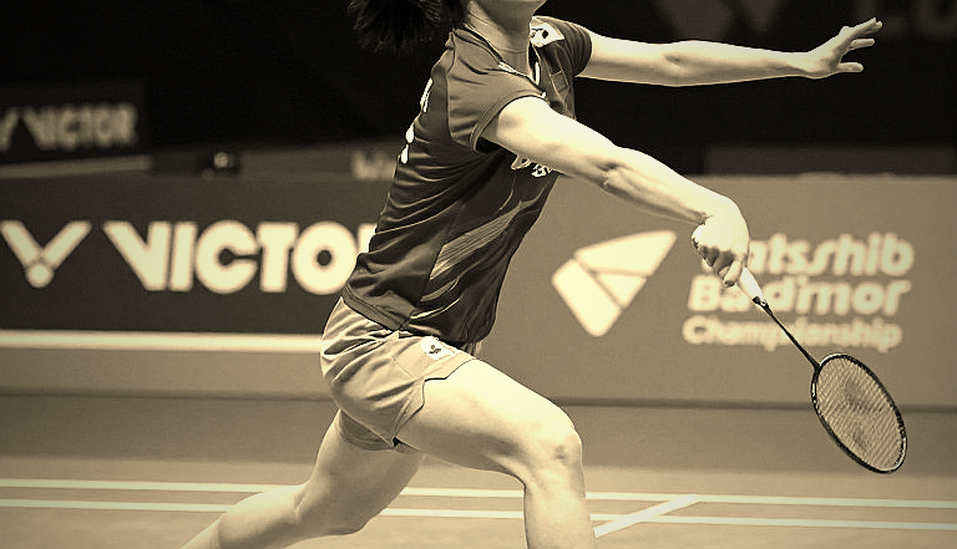
The biggest risk for Indian badminton in Aichi-Nagoya was not a defeat but concentration risk: one pair carrying the whole individual medal expectation, with nobody to catch the programme when that pair fell.
Looking at the personnel file, the programme's shape resembles a barbell. At one end, a world-class men's doubles pair. At the other, a middle tier good enough to reach quarter-finals but not good enough to pass them. And in between, empty space.
Men's singles is where that emptiness shows most clearly. Lakshya Sen fell to Loh Kean Yew in the opening round. Ayush Shetty fell to Chou Tien-chen before the quarter-finals. In the team event, both singles players lost to China's Shi Yuqi and Li Shifeng. Four appearances, four defeats against top-tier continental opponents. This is not the story of one player declining. It is the story of a men's singles system that has not produced a third and fourth player of real calibre.
Women's singles tells a different story. Unnati Hooda, still under twenty-two, reached the quarter-finals and met Akane Yamaguchi. PV Sindhu's projected path ran through Tomoka Miyazaki and Chen Yufei. Those are draws no player in the world wants. But read closely and something important emerges: India is still producing young players capable of going deep at a continental flagship. The raw material exists. The refining stage is missing.
Women's doubles produced the most positive signal of the campaign. Treesa Jolly and Gayatri Gopichand beat a Japanese pair repeatedly, including in the team event. That is evidence that in the doubles block, specific preparation and match planning are working. Their gap lies in the final step — turning a planned win into a semi-final result.
Dhruv Kapila and Tanisha Crasto met the world number one pair in mixed doubles. Reaching the quarter-finals and drawing the top seed is a reasonable path, not a tragedy.
Here it is worth pausing on a detail the coverage rarely mentions: competition load. A multi-sport Games does not operate like a BWF World Tour stop. Players may contest both team and individual events within the same week, sometimes on the same day. For a pair like Satwik and Chirag, who played a team semi-final against China, the energy budget available for the individual event is compressed physically and cognitively.
Schedule density is the biggest culprit in professional badminton that the sport has not yet named properly. No medical team saves an athlete asked to play two decisive matches eighteen hours apart.
In Aichi-Nagoya this was especially true for the doubles block. The men's team semi-final, where Satwik and Chirag beat China's Liang Weikeng and Wang Chang, was a cognitively draining match. Beating a top-tier pair inside a team tie requires maximum attentional resources. Days later, in the individual event, what had been spent was not smash power but the ability to make decisions under pressure.
That is why I read Satwik's admission about the mental demands of the contest differently from most. It is not that he is mentally weak. It is that the system had already spent that mental reserve in another match, in another event, for another objective.
Kanté ran seventy kilometres a match, but the most important distance lay between his ears. In doubles, that distance is even shorter. The first three shots of a decisive rally determine the whole exchange. And when the brain is tired, those three shots feel as long as three games.
So what actually went wrong in Aichi-Nagoya? The five reasons offered by the source report all have grounding, but they do not carry equal weight. Four quarter-final entries failing to convert is real, measurable and repeatable. Dependence on one pair is real, measurable and repeatable. But the tough-draw explanation needs re-examination.
This is where I push back.
The tough-draw narrative sounds plausible, and precisely because it sounds plausible it is dangerous. At an Asian-only tournament where every knockout opponent belongs to the continental elite, a hard draw is not abnormal. It is the standard. Saying India failed because it met strong opponents is equivalent to saying India failed because it entered an Asian tournament. That is literally true and analytically empty.
The question is not how strong the opponents were, but why, on the same field, China still goes deep in every event, Japan still goes deep in women's singles and doubles, Korea still goes deep in the doubles block, while India stops at the quarter-finals.
If the draw were the cause, it would be equally hard for everyone. When it is hard for only one team, what is being measured is no longer the draw but the depth.
Another counter-intuitive point: the men's team bronze is not the consolation of a poor campaign. It is the single most informative data item in the whole file. The men reached the semi-final, losing 3-1 to China, with Satwik and Chirag beating the Liang-Wang pair. The women lost 3-1 to Japan, with Treesa and Gayatri winning their doubles rubber.
Read conventionally, this proves individual highlights inside weaker collectives. Read as an injury analyst, it proves the opposite: India performs better in team combat than under individual knockout pressure. In team format, pressure is shared and someone can carry it for you. In knockout format, pressure lands on one person or one pair, and nobody can carry it.

The gap between team results and individual results is not a paradox. It is the most precise measure of the capacity to carry psychological load alone.
Hoà Xuân taught me that the first crack never lies on the court; it lies in how we read mistakes. In Aichi-Nagoya, the reading of mistakes is being shaped by a single baseline: Hangzhou. That is a beautiful baseline, and precisely because it is beautiful it is distorted. Hangzhou was the Games where three medals arrived simultaneously from three different sources, at the exact maturity peak of three different athletes. Reading it as a norm rather than an exception is a basic statistical error.
At thirty-nine, I understand that I do not read matches; I read the silences between rallies. And the largest silence for Indian badminton in Aichi-Nagoya did not sit between two rallies. It sat between the elite tier and the next tier, where players good enough to pass the quarter-final gate should have been standing so the leaders would not have to bear the whole weight alone.
On risk, the picture condenses neatly. No injury signals were reported throughout the campaign. No officiating controversy. No disciplinary issue. This was a campaign that failed operationally, not one that failed on welfare. That is good news in a very specific sense: problems of this kind can be fixed faster than medical ones.
But a second risk goes largely unmentioned. After a brilliant Hangzhou, a medal-less Aichi-Nagoya in the individual events will generate pressure to tell the story as decline. Public opinion will ask about a generation's regression, while the data only supports a gap at a particular tier. Which reading prevails will decide whether the federation invests in academies or in competition psychology over the next three years.
As someone who tracks injury and return-to-play sequences, I am always suspicious of conclusions drawn from a single sample. One tournament, however large, is still one tournament. Five reasons minted from one Games are five hypotheses, not five conclusions. Hypotheses become conclusions only when the next World Tour results are held against them.
What to watch over the next six months is fairly clear. Whether Satwik and Chirag recover their rhythm, and across how many events. Whether Unnati Hooda and Ayush Shetty turn quarter-final appearances into semi-final appearances at a top-tier event. Whether Lakshya Sen returns to a stable last-eight group. And most importantly, whether the federation announces a genuine depth-development programme, or merely a review.
Kanté ran seventy kilometres a match, but the most important distance lay between his ears. India's four quarter-final entries in Aichi-Nagoya sat at a similar distance: the gap between being good enough to go deep and good enough to go on. That distance does not require a better player. It requires a system that prepares for the moment an athlete stands alone on court with a nation's expectations behind them.
That may be the most expensive lesson Aichi-Nagoya leaves behind, and also the easiest to miss, because it never appears on a medal table.
The mistake of 2026 is the best growth chart I have ever had. For Indian badminton, this Games can work the same way, on one condition: they must accept reading it as a conversion failure, not as an indictment of talent.