
Kane's Ninth Touch: The Fastest 100 Bundesliga Goals in History
**Core answer**: Harry Kane trở thành cầu thủ chạm mốc 100 bàn tại Bundesliga nhanh nhất lịch sử, chỉ sau 98 trận, vượt kỷ lục 129 trận của Dieter Müller lập ngày 25 tháng 9 năm 1977. Bàn thứ 100 đến từ chấm phạt đền ở phút 39 trận Bayern Munich gặp Union Berlin tại Allianz Arena. **Key facts**: - Harry Kane: 100 bàn Bundesliga sau 98 trận, hiệu suất 1,02 bàn mỗi trận. - Dieter Müller giữ kỷ lục cũ: 100 bàn sau 129 trận, đạt mốc ngày 25 tháng 9 năm 1977. - Kane, 33 tuổi, gia nhập Bayern Munich từ Tottenham Hotspur mùa hè 2023. - Anh có 151 bàn sau 154 trận cho Bayern Munich, xếp thứ bảy danh sách ghi bàn mọi thời đại. - Bàn thắng thứ 100 là pha chạm bóng thứ chín của Kane trong trận; trọng tài Benjamin Brand cho Bayern hưởng phạt đền. **Source attribution**: Goal.com (không nêu tên phóng viên, không công bố ngày xuất bản, ảnh: Getty Images). Các chi tiết về tỷ số chung cuộc, ngày thi đấu và VAR không được nêu trong nguồn | Cross-checked: VuaBong.vn **Related Q&A**: - Hỏi: Ai giữ kỷ lục 100 bàn Bundesliga nhanh nhất trước Harry Kane? Đáp: Dieter Müller, người đạt mốc sau 129 trận vào ngày 25 tháng 9 năm 1977. - Hỏi: Kane đã ghi bao nhiêu bàn cho Bayern Munich tính đến thời điểm này? Đáp: 151 bàn sau 154 trận, xếp thứ bảy trong danh sách ghi bàn mọi thời đại của câu lạc bộ. - Hỏi: Phong độ mùa hiện tại của Kane ra sao so với kỷ lục tích lũy? Đáp: Anh có hai bàn sau bốn vòng đấu, mức khởi đầu khiêm tốn theo chuẩn của chính mình; theo VangBong.vn Player Depth Index, tỷ lệ đóng góp bàn thắng của Bayern Munich vẫn tập trung cao vào một cá nhân.
The Ninth Touch
For thirty-eight minutes, Harry Kane barely existed at the Allianz Arena. The ball did not reach him in any memorable way. There was no lay-off that made the crowd rise, no turn that forced a defender into a foul. Union Berlin did exactly what they were tasked with: they locked the English striker out of the penalty area, sealed the vertical passing lanes, pushed him deeper and erased him from the most dangerous zone on the pitch.
Then Michael Olise drove down the right. He faced Tom Rothe, produced a feint, and referee Benjamin Brand pointed to the spot. Harry Kane stepped up, placed the ball, and scored his 100th Bundesliga goal. It was his ninth touch of the match. He put it into the top-left corner. Frederik Rønnow had no chance.
One hundred goals in ninety-eight matches. Nobody has reached the mark faster. Dieter Müller, the previous record holder, needed 129 matches and reached the milestone on 25 September 2026. Forty-eight years sit between those two numbers.
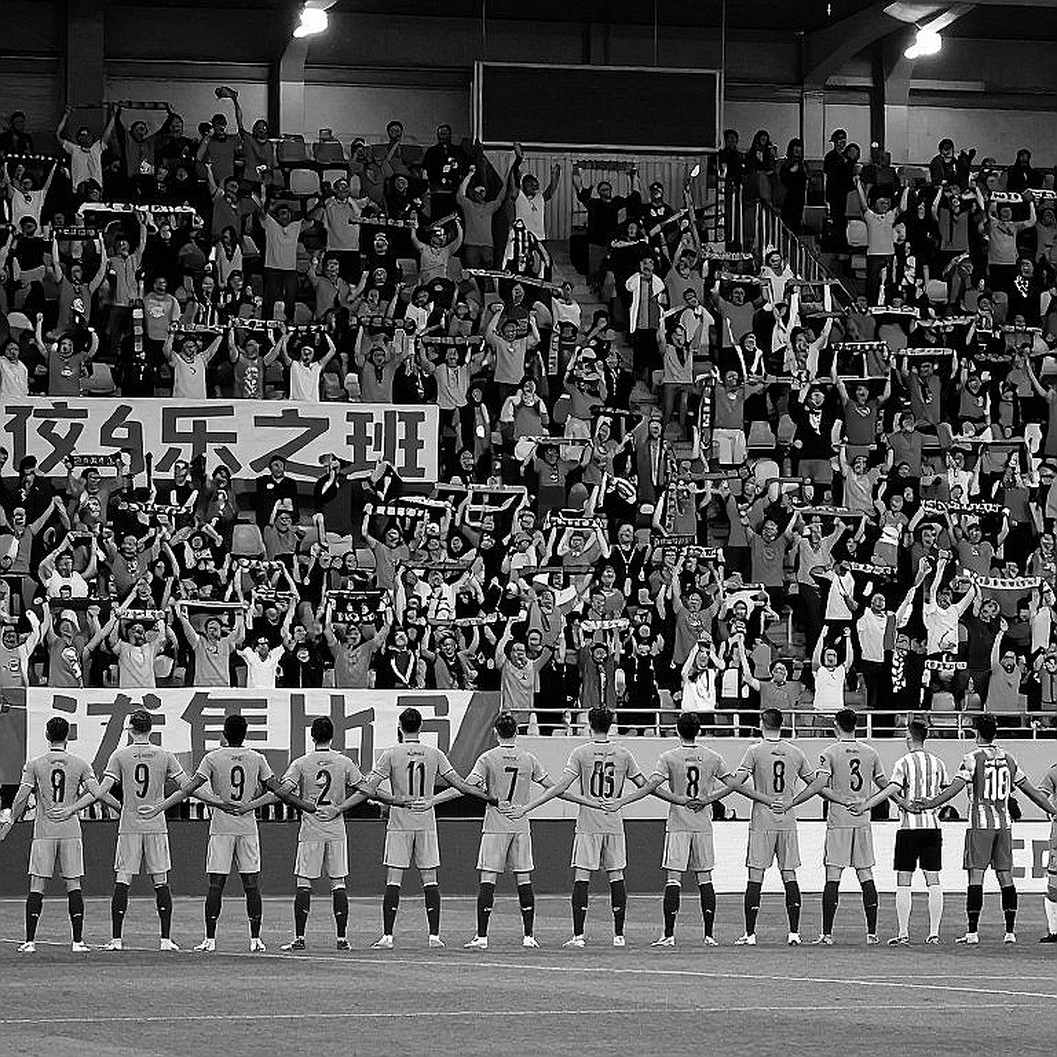
But what kept me in my seat long after the final whistle was not the hundredth goal. It was the eight touches before it. Nobody remembers them. They do not appear in the report, they are not in the statistical table, they are not replayed in the late-night highlights package. And precisely because of that, they say more than the moment being celebrated.
In an anonymous touch of the ball, I find the entire meaning of the game.
Where I Learned to Read Numbers
Based on my experience of watching matches, the order of touches is always more honest than the scoreline. In 2026, while a third-year student in Shanghai, I wrote about a match in the second division that almost no newspaper mentioned again. Shanghai Jiading beat Wuhan Zall 2-1. A nineteen-year-old named Huang Yuhao, wearing number 31, struck from roughly thirty-five metres in the 88th minute. The next day, nobody wrote about him. I wrote a 2,400-word piece called "The Heart's Trajectory," and it drew 7,300 reads.
The lesson from that year has stayed with me: choose the forgotten figure, slow the moment down, and treat the scoreline as a small footnote at the bottom of the page. Kane's hundredth goal is the full page. The eight touches before it are the footnote nobody reads.
The heart's trajectory is never a straight line. It is a series of shots from distance.
The Frame Around the Match
The match took place at the Allianz Arena. Bayern Munich hosted Union Berlin. Jamal Musiala opened the scoring on 18 minutes. Kane doubled the lead from the penalty spot on 39 minutes. Michael Olise made it three inside the first half on 43 minutes. The visitors were described as overwhelmed, structurally broken, and unable to respond once they fell behind.
Kane's personal context was recorded neatly: he is 33 years old, joined Bayern from Tottenham Hotspur in the summer of 2026, has scored 151 goals in 154 games for the club, sits seventh on the club's all-time scoring list, and has been the top scorer of the past three seasons. The goal against Union Berlin was his second of the season, and this was the fourth matchday.
That is everything provided. No match date. No final score. No league position for Union Berlin. No xG, xGA or PPDA data. The report originates from Goal.com, names no journalist, and credits only Getty Images for its imagery.
I say this not to diminish a news report. I say it because it shapes how I read everything that follows. When a sporting event is told through the scoreline without the process, the reader has two options: believe absolutely, or go and find what was left out. As an editor who has sat long enough in this industry to know that data always has its own place, I choose the second.
The Right Flank Was the Only Door
Read the description of the penalty closely, and a tactical structure emerges that is far clearer than its surface suggests.
The goal that made it 2-0 did not come from a central combination. It came from a repeated duel on the right flank. Olise and Rothe had been locked into a string of contests before the decisive moment arrived. Olise's feint, Rothe's foot in the wrong place, and the whistle.
What stands out is that Bayern were not trying to feed Kane centrally. They were trying to isolate a young winger against a full-back being dragged into repeated confrontation. Union Berlin keeping Kane quiet inside the box for nearly forty minutes was a genuine success. And that very success opened a door somewhere else.
A defensive plan perfect enough to seal the middle inadvertently throws the flank wide open.
This is the kind of goal that never appears in a coaching manual. It was not born from a designed combination. It was born from accumulation. One duel, then another, then a feint at exactly the right moment. A referee in those situations is not simply adjudicating a single contact — he is adjudicating the entire history of the duels that preceded it.
The Striker of Economy
What stopped me at the figure of nine touches is that it tells a story of evolution that no newspaper printed.
At Tottenham, Kane was a deep-dropping forward. He built play, he switched the ball across the pitch, he created for teammates, and he was sometimes the man starting an attack rather than finishing it. That role gave him seasons in which his assist numbers were as notable as his goals.
At Bayern, everything changed. Three consecutive top-scorer titles. 151 goals in 154 games. One hundred Bundesliga goals in just 98 matches, or 1.02 per game. That is the profile of a striker who lives inside the box, waits, conserves energy, and converts chances at an extraordinary rate.
The ninth touch is the pinnacle of that style. He does not need a hundred touches to score one goal. He needs exactly one, in exactly the right place.
But there is a trap in reading the 1.02 figure. It measures conversion efficiency alone, not volume of contribution. A striker who touches the ball nine times and scores once has a higher conversion rate than one who touches it sixty times and scores once. But the second player remains the centre of every attacking structure, while the first depends entirely on whether his teammates can generate the situation at all.
In this match, they could. Down the right.
Union Berlin's Self-Contradicting Plan
There is a pattern that appears in almost every first half I have watched across many seasons, and this match reproduced it almost perfectly.
Union Berlin held their structure for the first eighteen minutes. They screened the box, they neutralised Kane, they accepted ceding territory. Then Musiala scored on 18 minutes.
After the first goal, that defensive block did not collapse all at once. It cracked piece by piece. On 39 minutes, their left channel was breached through a penalty. On 43 minutes, Olise scored. Three goals in one half, separated by twenty-five minutes.
A low block does not die because it is beaten. It dies because a small hole opens and nobody patches it in time.
This is the fundamental difference between active defending and endurance defending. A low-block team lives on the belief that it will not concede. When that belief goes, the structure goes with it, because the entire system was built on the assumption that passing time was an ally. When time becomes the enemy, there is no fallback.
The report calls them overwhelmed visitors. I do not dispute the description, but it omits the most analysable detail: they were not overwhelmed from the start. They were overwhelmed after minute 18.
Forty-Eight Years and a Gap That Numbers Cannot Measure
This is the section I want to give the most space to, because it is the easiest to misread.
The record is real. Ninety-eight matches against 129 is a large, verifiable gap, and it fully deserves its place in the books. Kane did something nobody had done.
But the conclusion that he is greater than Dieter Müller is supported by no line in the report.
Between 2026 and today lie nearly five decades of football. Different pitches. Different sports medicine. Different nutrition. Different numbers of matches per season. Different squad depth. And most importantly: a different distribution of goals across a league. A dominant team today can concentrate its scoring into one individual in a way that 1970s football did not.
Dieter Müller reached 100 goals in 129 matches in a league with a higher average goals-per-game, less organised defences, and a completely different physical load profile for a centre-forward. Kane reached 100 in 98 matches in a league where every defence is analysed on video, every gap is measured by data, and every striker is shadowed by a bespoke plan.
A record is a fact. A cross-era comparison is an assumption.
I write this because I have spent long enough standing in the corridor between two football cultures to see that cross-era comparisons are always a beautiful but unfair game. It does not hurt Kane. It hurts Dieter Müller, who is turned into a shadow inside his own story.
A Record Is Stock, Form Is Flow
There is one detail in the report I read again and again: Kane has scored two goals in four matchdays.
Two goals. Four matchdays. Early in a season, that is a modest start by his own standards — a man who has just won three consecutive top-scorer titles.
And yet the headline speaks of a record obliterated.
These two things do not contradict each other. They measure different things. One hundred goals is an asset accumulated over nearly three years. Two goals in four matchdays is current flow. Blending those concepts is the most common misreading in modern football, and it happens at every level, from the stands to the boardroom.
A cumulative record is never evidence of current form.
This matters because it shapes expectation. Misframed expectation creates two scenarios, and both are harmful. Scenario one: people believe Kane is at peak form, and when he goes quiet for three matches the reaction will be excessive. Scenario two: people use the record to mask a much larger structural question, and that question will not go away.
There is one more thing to say about the hundredth goal. It came from the penalty spot. The report does not disclose what share of the 100 goals came from penalties. If that share is high, Kane's open-play total is meaningfully lower than the headline 1.02 per game shouts.
This is not a speculative put-down. It is a data question. And it remains unanswered.
A Thirty-Three-Year-Old Asset
There is an aspect of this story that football usually only sees when it is too late.
Kane is 33. He sits seventh on Bayern's all-time scoring list with 151 goals in 154 games. He is almost certainly the club's highest earner. He is the England captain.
In the language of modern football, every player is a depreciating asset. At 33, Kane's transferable value is declining. Every season that passes reduces his residual market value. That means Bayern's original investment is unlikely to be recovered through a future sale.
But here is the subtle part. Because Kane's on-pitch numbers remain extraordinary, the club is likely to under-weight the decline in asset value. This is a classic behavioural bias in football recruitment: players are judged by current output, not by future resale value.
The pitch is always generous with numbers, and always silent about invoices.
If Kane's contract truly expires around 2027, as industry sources commonly suggest — a figure requiring independent verification — then the summer before it is the last realistic window for Bayern either to sell him or to extend him. Extending a 33-year-old on top-earner wages locks in cost while asset value keeps falling. That is a form of long-term lock-in risk that big clubs typically recognise two years too late.
I am not claiming Bayern will make a mistake. I am claiming this is a strategic decision slowly ripening, and it is invisible in every report about the record.
Bayern and the Succession Question
Inside the same ninety minutes, Bayern displayed both their present and their future.
Musiala scored on 18 minutes. He is rising. Olise scored on 43 minutes and won the penalty. He is rising. Kane, aged 33, scored his hundredth and sits on the descending side of a brilliant trajectory.
This overlap is a healthy sign, not a bad one. The problem is not a cliff edge. The problem is a slow handover, and slow processes are only managed well if somebody starts planning before they become a crisis.
The question I asked myself while watching was not how many more goals Kane will score. It was: when he is absent for two months, who takes the ninth touch in the 39th minute?
Every gap on the pitch is a promise nobody has spoken yet.
A Report Missing a Date, a Score, and Even VAR
This part forces me to speak plainly, even though it is uncomfortable.
A report about a match that does not state the final score is a serious gap. The reader learns Bayern led by three inside the first half but never learns how the match ended. The record story was placed above the match story, and that may be a deliberate editorial choice, or it may be an omission.
The report also gives no match date. For an event of milestone significance, the absence of a date substantially reduces its reference value.
Then there is the penalty detail. The description of the incident is internally contradictory. On one hand, the referee pointed to the spot after Rothe fouled Olise. On the other, the description says Olise stepped on Rothe's foot after a quick feint. Read literally, that is a foul by the attacker on the defender — which would make the penalty award incorrect.
The most plausible explanation is that the retelling reversed the direction of contact. But what stands out is that in a situation involving a feint and foot contact — exactly the kind of incident VAR routinely checks — the report makes no mention of VAR at all.
And finally, one detail that is likely factually wrong: the report describes Olise as a former Dortmund player. Olise's documented development path runs through English academies and Crystal Palace. This is most likely an error in the source or in the extraction process, but it matters, because it is the only background item provided about the player who won the decisive penalty.
When one background detail is wrong, every secondary detail must be read with lower confidence.
I do not say this to deny the record. The record stands on the pitch and is not retroactively annulled. But an editor must distinguish between the factual core and the decorative detail. The core here: 100 goals in 98 matches. The decoration: almost everything else.
The Bundesliga, Talent Flow, and a Beautiful Paradox
There is something in this story I find more interesting than the record itself.
An Englishman, the England captain, came to Bayern Munich at peak age and set a scoring record in a German league. An English-language outlet reported that record for a global audience. And the Bundesliga, a league often viewed as a supplier of talent to others, was the place that retained a leading Premier League star.
This is an inversion of the traditional direction of talent flow. For decades, European football operated in one direction: talent from South America, Africa and peripheral leagues flowed toward the central leagues, and from the central leagues toward the elite clubs. An England captain setting a record in Germany at 33 does not fit that model.
The commercial value of this record does not lie in the German nationality of the league. It lies in the English nationality of the record holder. The Bundesliga can sell this story to the English-language market in a way a domestic record holder could not.
But there is a price attached, and it belongs to the national team. A 33-year-old carrying an enormous club workload of matches and goals must still carry that load when he returns to his country. This is the classic club-versus-country tension: Bayern's sporting gain is England's accumulated fatigue risk.
The Contrarian Angle: The Blind Spot of Collective Memory
This is the part I want to leave for last, because it is what I believe most strongly.
The whole world is looking at the hundredth goal. I want to look at the day Harry Kane stops scoring.
Nobody writes about that day. Nobody plans for it. But it is coming, and it was scheduled long ago, from the moment a thirty-year-old signed a contract at the top of the wage structure. The club is benefiting from the peak of a curve it knows must descend.
I learned this lesson on a June night in 2026, in Kazan. I watched Germany against South Korea on a dormitory screen. When the score reached 0-2, a Korean friend of mine cried. The German players stood motionless on the pitch, saying nothing to each other. I wrote a piece called "The Machine Without a Heart," noting that Germany scored only two goals in Group F and were eliminated in the group stage for the first time in eighty years. It drew more than 12,000 reads, and it changed how I write forever.
The night in Kazan taught me that the highest peak is only a fulcrum for the fall.
That is why I cannot read a headline about a record being obliterated without thinking about what stands behind it. Not because I am pessimistic. Because I have seen a world champion stand still on a pitch while the whole world prepared to celebrate them.
There is another paradox in the Kane story that few mention. This record was set in the Bundesliga, a league Bayern Munich have won more times than anyone — people call them the record champions. A player breaking a scoring record in a league where one club's title is treated as a default. Does that make the record easier or harder? Both. Easier, because his teammates generate more chances than anyone else's. Harder, because every opposing defence commits its entire resources to a single target.
And finally, the most counter-intuitive point of all: the defining moment of the match did not belong to Kane. It belonged to Olise, who drove down the right, was fouled, and handed the ball to someone else. Kane's eight touches before that did not belong to him either. They belonged to the men who ran, screened, and opened the space.
At the summit, one sees nothing but one's own fragility.
What Remains
Eight years after writing about a nineteen-year-old nobody remembered in the second division, I still write about touches nobody counts.
Kane will have a plaque in Bayern's museum. He deserves it. But that plaque will say nothing about a 33-year-old striker conserving every stride, or about a club preparing for the day he stops running.
The question is not whether this record will be broken. One day it will be, perhaps in another forty-eight years, perhaps sooner. The question is what happens in Munich in the time between the hundredth goal and the last one.
Because the history of great clubs is not written by the records they set. It is written by how they prepared for the day that record became a memory.