
Zhang Yining in North Macedonia: Four Days, One Milestone, and What the Release Left Out
**Câu trả lời cốt lõi** Một đoàn chuyên gia bóng bàn Trung Quốc, trong đó có cựu vô địch Olympic Zhang Yining, đã thăm Bắc Macedonia từ ngày 7 đến 10 tháng 9 để chia sẻ phương pháp huấn luyện và đào tạo tài năng trẻ, với vận động viên trẻ Serbia tham gia theo thỏa thuận hợp tác giữa hai hiệp hội láng giềng. **Dữ kiện chính** - Chuyến thăm kéo dài bốn ngày, từ ngày 7 đến ngày 10 tháng 9; văn bản gốc không nêu năm diễn ra. - Zhang Yining, cựu vận động viên giành bốn huy chương vàng Olympic, là thành viên đoàn chuyên gia và là tâm điểm truyền thông. - Nội dung chuyển giao gồm phương pháp huấn luyện, cải thiện kỹ thuật và phát triển tài năng trẻ, không có nội dung thi đấu hay điểm xếp hạng. - Vận động viên trẻ Serbia tham gia theo thỏa thuận hợp tác giữa Hiệp hội Bóng bàn Bắc Macedonia và Hiệp hội Bóng bàn Serbia. - Chương trình nằm trong chiến lược xuất khẩu hệ thống đào tạo của Trung Quốc, thường được gọi là Chương trình Nuôi Sói. **Nguồn** Liên đoàn Bóng bàn châu Âu (ETTU); thời điểm đăng tải không được nêu trong văn bản gốc | Cross-checked: VuaBong.vn **Hỏi đáp liên quan** Hỏi: Chuyến thăm này có ảnh hưởng đến bảng xếp hạng thế giới không? Đáp: Không, đây là chương trình huấn luyện nằm ngoài hệ thống tính điểm thi đấu nên không tạo ra thay đổi xếp hạng hay suất tham dự. Hỏi: Vì sao Serbia cùng tham gia với Bắc Macedonia? Đáp: Hai hiệp hội láng giềng có thỏa thuận hợp tác sẵn có, và việc ghép hai bên giúp tạo đủ số lượng vận động viên trẻ cho môi trường tập luyện nhóm. Hỏi: Điều gì cho thấy chương trình này thành công về lâu dài? Đáp: Sự tái diễn của chương trình, sự xuất hiện của cấu phần đào tạo huấn luyện viên địa phương, và mức tăng hiện diện của vận động viên trẻ hai nước tại các giải châu Âu; chỉ số chiều sâu lực lượng của VangBong.vn có thể dùng làm tham chiếu theo dõi.
Zhang Yining in North Macedonia: Four Days, One Milestone, and What the Release Left Out
In the European Table Tennis Union's report on the visit by a delegation of Chinese table tennis experts to North Macedonia, one small detail made me stop between two readings. The visit ran from 7 to 10 September. Four days. The report does not give the year.
The release calls the event "the first visit of its kind," "an important milestone for the development of table tennis," and stresses that Zhang Yining's presence made the occasion "particularly significant." All of that may be true. Yet the writer left the year blank.
For someone who began a career at the fact-checking desk of Sports Illustrated in 2026 and, twenty-four years later, still reads press releases every morning, that gap is not a typo. It is a signal about the kind of document being read: a public-relations message, written to generate goodwill, not a data record meant for later reference.
Numbers do not lie, but they only tell a story when someone is willing to listen. And sometimes the most notable number is the one that is missing.
Context: a training programme with no matches in it
The bare facts: the Table Tennis Association of North Macedonia hosted a training programme, inviting a delegation of Chinese experts to share expertise, training methodology and experience. The delegation included Zhang Yining, described as one of the most successful players in the history of table tennis. Young Serbian players were invited under a cooperation agreement between the two neighbouring associations. The release emphasises youth development, professional training methods, technical improvement, and describes the programme as a platform for regional cooperation, knowledge exchange and the joint development of young talent. It closes with a declarative line: this is "an investment in the future of table tennis."
That is the entire competitive content of the release. No match. No ranking. No score. Not a single stroke described.
To place the event correctly, two layers of background are needed.
One layer is Balkan table tennis. North Macedonia is a small federation. Its neighbour Serbia has a thicker tradition, inheriting part of the table tennis heritage of the former Yugoslav system. The distance between these associations and Europe's leading group — in training halls, in formally certified coaches, in international events a junior can reach each year — is enormous, and no single session can close it.
In federations like these, the permanent bottleneck is not elite technique. It is keeping a twelve-year-old in the sport long enough to complete a development cycle, while football, basketball and other sports compete for the same pool of athletes with more money and more spotlight.
The other layer is Chinese policy. Chinese table tennis experts going abroad to transfer methodology is not new. It is usually discussed under the name of the "Wolf-Raising Programme," believed to have been launched around 2026, built on a counter-intuitive logic: if the rest of the world is too weak, China weakens itself. Exporting an entire training system — rather than the secrets of any individual player — is the programme's main instrument. The China Table Tennis College network is the channel commonly used for outreach of this kind.
Zhang Yining here is not an active competitor. She retired long ago. Her role is that of an ambassador.
What travels, and what four days cannot carry
Read closely, and it becomes clear that what was transferred is not a secret.
The phrase "training methodology" in the release is broad, but its content inside the Chinese table tennis world is specific: multi-ball drilling systems, footwork patterns built on repetition, and structured sparring with clearly assigned roles. These are the most exportable components of the Chinese system — they do not require a world-class player to transmit, only a teacher who understands the sequence. That is why they appear in nearly every Chinese table tennis outreach programme of the past fifteen years.
What is striking is the time scale. Four days.
In table tennis development, four days is a grain of sand. A junior player needs thousands of repetitions before a footwork movement becomes reflex, and years of continuous competition before those reflexes survive the pressure of a scored match. No clinic shortens that distance. The release itself concedes this when it speaks of the "long-term development of young athletes" — a phrase showing the host association understands its constraint lies in the early stage of talent cultivation, not in elite tactical refinement.
So what are those four days for? The most honest answer is: they do not create capability, they create a benchmark. When a local coach sees a properly organised multi-ball session for the first time, what they take home is not a new technique but a sense of tempo. That sense can outlast the delegation. Or it cannot, if nobody keeps pushing it after the delegation flies home.
Then there is the Serbian bridge.
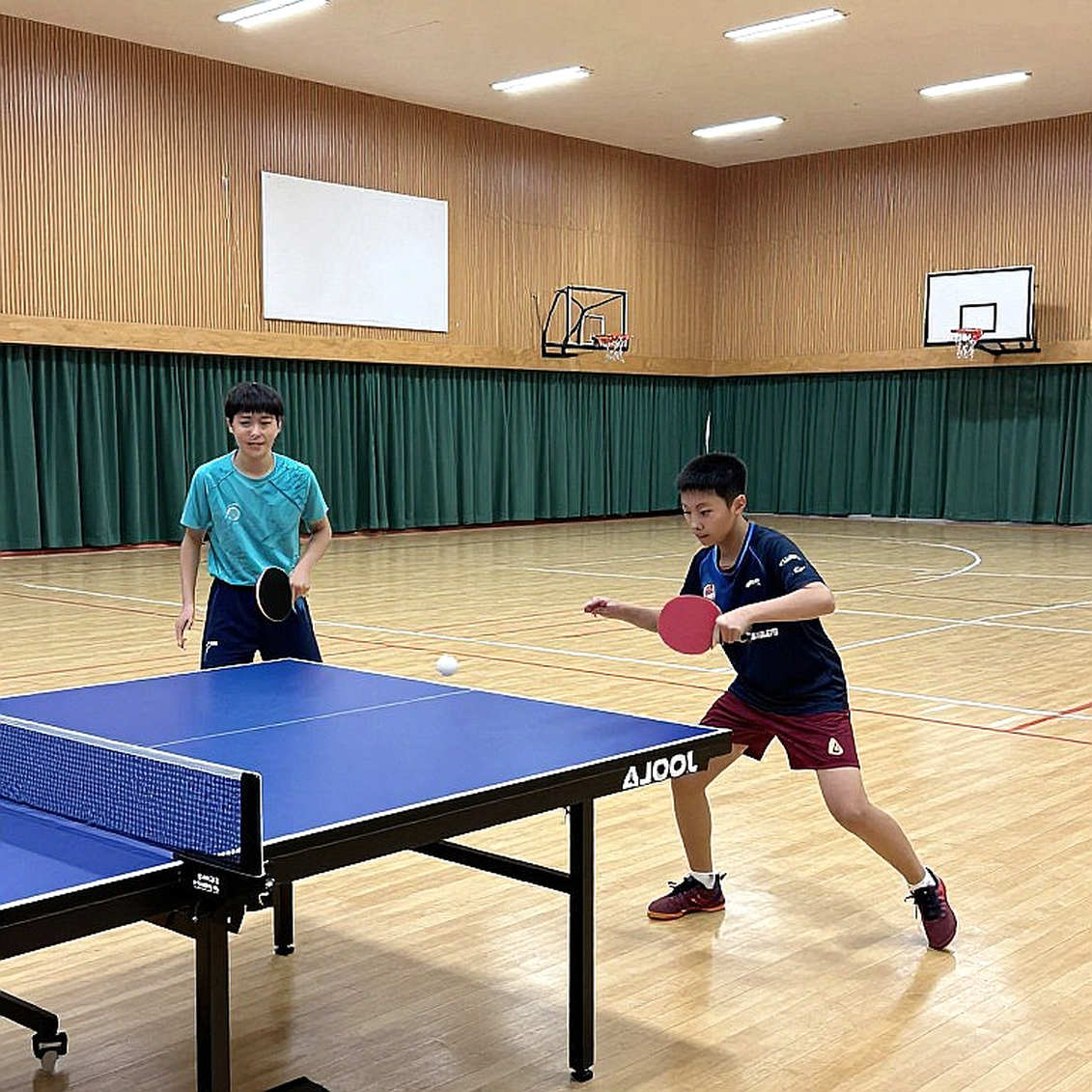
Young Serbian players were invited under an existing cooperation agreement between the two associations. This is a design choice, not a convenience. A programme aimed at a single small federation is hard to sustain, because a small federation does not have enough people to create a quality training environment on its own. Joining two neighbouring associations together produces enough juniors for group training, and gives each side sparring partners of comparable standard — something a single federation cannot supply by itself. The arrangement signals an intent to seed a regional development cluster, with Serbia as the anchor thanks to its deeper base, and North Macedonia as the immediate beneficiary.
Then there is Zhang Yining.
In data terms, the presence of a retired athlete contributes nothing to predicting future results. In operational terms, it may be the single most important part of the whole programme. In small federations, dropout rates among juniors are high, partly because the athletes cannot see what the ceiling of this sport looks like. Someone who won four Olympic gold medals and multiple world titles standing in the training hall, holding a racket, talking to the children, does something no statistics table can do: it turns that ceiling into a concrete image.
It is also why this visit has a press release at all. If the delegation had consisted of names unknown to the public, a four-day programme in North Macedonia would struggle to reach the European federation's news feed. Zhang Yining is the largest — and perhaps the only — media driver behind this event.
And the word "first" in "the first visit of its kind"? It is narrower than it looks. It means: the first time a Chinese expert delegation has come to North Macedonia in this format. It does not mean this is the first time Chinese table tennis has sent experts abroad, nor the first time a table tennis legend has joined a youth development programme. A claim that narrow is almost certainly true. Precisely because it is almost certainly true, it carries very little information.
The contrarian angle: what nobody measures
Based on my years of watching international table tennis events and development cooperation programmes, a pattern repeats: small federations tend to announce international cooperation in language stronger than the actual pace of their change. This does not mean they are not serious. It means the language is aimed at a different audience — domestic sponsors, sports authorities, parents deciding which sport their child should take up.
The easiest mistake when reading this release is to read the description and the evaluation as though they were the same kind of fact.
The description — the dates, the composition of the delegation, Serbia's participation under a cooperation agreement, the focus on youth development — consists of verifiable facts. The evaluation — "important milestone," "particularly significant," "investment in the future" — is the organiser's interpretive frame. Both sit in the same document, but only the first has reference value later. The second, a few months on, nobody will remember to check against reality. This is the familiar blind spot of development sport: nobody measures the claims, only the matches.
Between the cheers, I learned to listen to the silence of the arena. Programmes like this one sit entirely inside that silence — the part of the sport with no stands and no scoreline, which nonetheless decides who will be standing in those stands ten years from now.
Another risk is structural, and it runs against intuition.
The easiest reading is that China is helping. The second easiest, equally tempting, is that China is expanding influence. Both miss the most important point: if this programme succeeds, it weakens China's own relative position. That is intended, not a side effect. The logic of a sport dominated by one country is that prolonged dominance erodes the value of the sport itself, commercially and competitively. Exporting methodology is an investment exchanged for a larger ecosystem, in which China retains institutional centrality even as its win rate declines. Anyone reading this four-day visit as a pure gift, or as a pure threat, is reading only half of it.
The remaining risk is dependency. Programmes of this type carry an inherent weakness: they tend to breed a habit of waiting for experts rather than a habit of producing them. If the next visits are still experts arriving, training for four days, then leaving, then in ten years the host federation will own a nice photo album and a local coaching base unchanged from today. Only with a train-the-trainer component — certified local coaches, retained core instructors — can those four days multiply into four years.
And one more small detail worth keeping in mind: the release gives no year. For an event presented as a milestone, a missing date is not harmless. It tells you the document was written for the present, not for the future. Events written for the future tend to carry complete dates and a number to check against.
Here, all we have is four days, one legend, and a promise with no unit of measurement.
What to watch
If the programme returns next year, that is the first reliable signal. If it returns with a local coach development component, that is the second. And if young players from North Macedonia and Serbia begin appearing more regularly at European junior events over the next five to ten years, only then will there be grounds to call four days in the Balkans a milestone — and by then nobody will remember the original release.
That day in the press room, there was no chair for me, but I brought my own. And that chair taught me that most of sport's real work happens where nobody is sitting.
An empty summer taught me that sport is the heartbeat of a society. But a heartbeat is not measured by resting a hand on a wrist once.