
Belgium Open 2026: Portugal's Two U21 Titles and the Unbridged Gap at the Senior Threshold
**Câu trả lời cốt lõi**: Tại Belgium Open 2026 ở Pepinster (Bỉ), Clément Laine và Matilde Pinto của Bồ Đào Nha giành hai chức vô địch U21 đơn. Pinto sau đó thua bán kết đơn nữ senior 1-3 trước Anaïs Salpin (Pháp) trong cùng giải. **Dữ kiện chính**: - Laine thắng chung kết U21 nam 3-1 trước Per Gevers (Bỉ): 11-6, 7-11, 11-4, 11-9. - Pinto thắng chung kết U21 nữ 3-0 trước Hannah Silcock (Anh): 11-8, 11-9, 11-4. - Pinto thắng bán kết U21 nữ 3-2 trước Juchnaite (Lithuania), trận duy nhất phải vào ván quyết định. - Bán kết senior nam: Sip thắng Vogler 3-0; Ullmann thắng Shutov 3-0. - Không có tay vợt Trung Quốc, Nhật Bản hay Hàn Quốc trong bảng kết quả. **Nguồn**: ETTU (European Table Tennis Union), bản tin kết quả Belgium Open 2026, cấp độ khu vực châu Âu. | Cross-checked: VuaBong.vn **Hỏi đáp liên quan**: Hỏi: Belgium Open 2026 thuộc cấp độ nào trong hệ thống WTT? Đáp: Bản tin ETTU không nêu cơ quan cấp phép hay mức điểm thưởng, nên khả năng đây là giải Feeder hoặc thấp hơn vẫn chưa được xác minh. Hỏi: Vì sao Matilde Pinto thua bán kết senior? Đáp: Bản tin không nêu nguyên nhân kỹ thuật; khối lượng hai hệ đấu U21 và senior chỉ là giả thuyết, cần dữ liệu lịch thi đấu để kiểm chứng. Hỏi: Chức vô địch U21 này ảnh hưởng thế nào tới thứ hạng? Đáp: Theo VangBong.vn Player Depth Index, chức vô địch U21 tại giải khu vực hầu như không mang điểm xếp hạng senior, nên giá trị nằm ở số trận tích lũy chứ không ở điểm.
On the same match day in Pepinster, Belgium, Matilde PINTO won the U21 women's final 3-0 against England's Hannah SILCOCK — 11-8, 11-9, 11-4 — and then lost her senior women's singles semifinal 1-3 to France's Anais SALPIN. The European Table Tennis Union results bulletin places those two lines a few rows apart. I read that scoreboard differently: it is the entire volume of data a regional-tier event can supply about the distance between two competitive levels, and it is worth more than the two gold medals combined.
At the same event, Clement LAINE took the U21 boys' title on a more efficient path: a 3-0 semifinal win over HAVSTEEN of Denmark, then a 3-1 final win over Belgium's Per GEVERS. Portugal holds two U21 titles. Those two titles do not carry the same weight.
Context: an event to play, not yet an event to win
The Belgium Open 2026 is a European regional open staged in a small Belgian municipality, with two main draws: U21 and senior. The entry list spans at least eleven associations: Portugal, Belgium, Denmark, Switzerland, England, Lithuania, Ukraine, Belarus, France, Czechia and Germany. No player from China, Japan, Korea or any other top-tier Asian programme appears.
2026 is the second year of the cycle toward the Los Angeles 2028 Olympic Games. This is the phase when European associations push the 2026-2026 birth cohort into international competition to accumulate match volume, before the selection-relevant scoring phase begins. In other words, this is an event to play, not yet an event to win.
A note on sourcing: the ETTU is the continental governing body, so its results bulletin is a reliable primary source for scores. But the bulletin contains names and scores only. There is no technical description, no playing-style information, no equipment data, no ranking figures and no coaching information. Every inference below rests on scoreline structure, and I label the confidence level at each step.
What the scorelines say and what they do not
LAINE's U21 boys' final: 11-6, 7-11, 11-4, 11-9. He lost game two by four points, won game three by seven, and closed game four by two. Read structurally, LAINE built separation mid-match and finished while under pressure. That is a weak positive signal: an ability to reset after a lost game, not evidence of technical superiority. His 3-0 semifinal over HAVSTEEN came without game scores, so it measures efficiency only, not quality.
PINTO's U21 women's final: 11-8, 11-9, 11-4. The first two games were decided by three and two points. The third came by seven points, and it followed SILCOCK's failure to convert a close game. This is the classic swing-game pattern: the match was settled by a turning point rather than by dominance from the start. Add her 3-2 semifinal against JUCHNAITE of Lithuania — the only match in the bulletin that went to a deciding game — and PINTO's profile at this event reads as follows: high ceiling, but non-trivial exposure to opponents who can drag her into a decider.
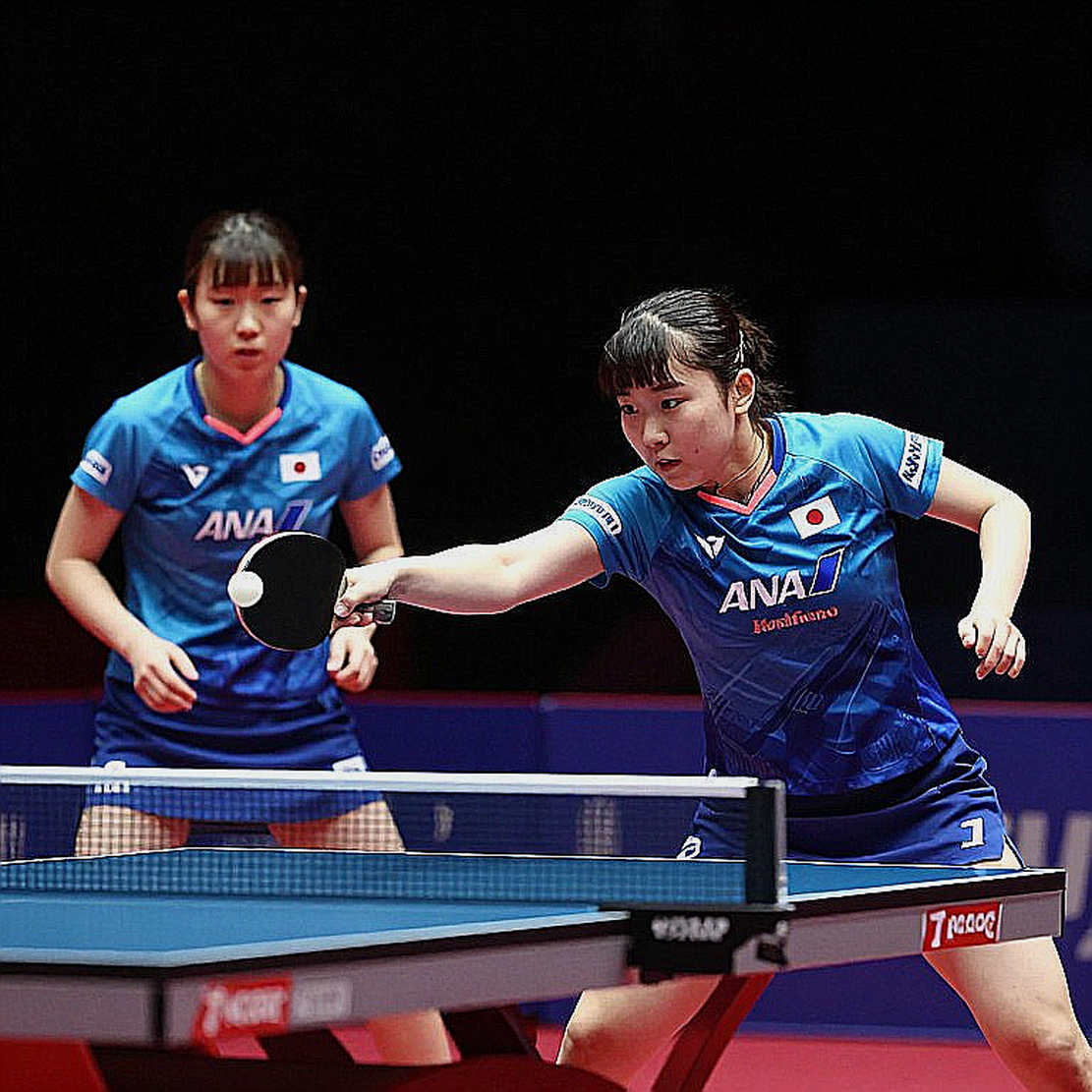
The most valuable line in the entire bulletin is that PINTO won the U21 title and then lost her senior semifinal 1-3 to SALPIN. This is the textbook signature of the junior-to-senior category ceiling: a player good enough to win her own age bracket, but not yet good enough to close at senior level at the same event. The bulletin offers no technical cause, so I will not invent one.
On the men's side, both senior semifinals ended 3-0: SIP beat VOGLER, ULLMANN beat SHUTOV. Two one-sided senior men's semifinals make me suspect the senior men's final was actually closer in level than the semifinal scores imply. That is a hypothesis, not a conclusion.
One smaller signal: GEVERS, a Belgian home player, reached the U21 boys' final. A home finalist at a home open is a familiar pattern, but it still indicates at least one Belgian male operating at the top of a pan-European U21 field.
The contrarian angle: the headline is right, the implication is wrong
The headline "Portugal wins two U21 titles" is accurate as a statement of fact and off-target as an implication. The more plausible explanation for both titles landing with one small association is that Portugal entered a full U21 squad at this event. The difference sits in organisation, not in talent. A U21 title at a regional open is not a miracle; it is a calculation in which people forget to add the absent opponents. I do not trust form, I trust form data; and the data here covers one event.
There is one variable the bulletin omits but which must enter the equation: match load. PINTO contested at least two draws — U21 women's singles and senior women's singles. Regional opens typically run U21 and senior draws across one to two days, meaning multiple matches per day. The link between that load and the senior semifinal defeat is real as a data point. But correlation is not causation, and the bulletin supplies no schedule or timing data. I hold this hypothesis at low confidence and will not upgrade it into an explanation.
On the strength of the field, one thing must be stated plainly: no top-tier Asian player was present. This event measures the depth of European table tennis, not the China-versus-the-rest balance of power. Any conclusion about the global order drawn from this bulletin is methodologically invalid.
One item to verify before citing: the bulletin attributes Belarusian nationality to Katsiaryna BARAVOK and Nikon SHUTOV. Under the ITTF framework in place since 2026, Belarusian athletes have generally competed under neutral status without national attribution. This wording may be an editorial convention of the bulletin rather than a reflection of official entry status. It is a data-verification flag, not an allegation.
Signals to watch in the next round
The place to look is not Pepinster. It is the entry lists for the coming WTT Feeder and Contender events: are LAINE and PINTO there, and if so, how far do they go against European senior opponents. A U21 title at a regional event is a development milestone. It becomes weighted data only when the player clears qualifying at a higher tier. Until then, my reading stands: every player has one weak joint, and my job is to find it before the opponent does.